How much does it cost to start woodworking?
For a beginner, the answer is not simply the price of a saw or drill. A usable starting budget also needs to account for measuring tools, workholding, safety gear, abrasives, glue, fasteners and enough wood to complete a first project.
That changes the math.
A $500 budget can disappear surprisingly quickly if most of it goes into one machine. On the other hand, a carefully balanced setup can give a beginner enough capability to build real projects for far less than the cost of a full workshop.
For this guide, we built three realistic U.S. starter budgets—approximately $250, $500 and $1,000—and asked a different question at each level:
What woodworking capability does this amount of money actually buy?
This is not a list of products you must purchase. It is a budgeting model designed to show how a beginner can distribute money across the parts of woodworking that actually make projects possible.
Editorial & pricing disclaimer: This article contains no affiliate links. KuduPost receives no commission from any retailer or manufacturer mentioned in the research behind this guide, and no company paid to be included. The article was written for informational and editorial purposes, without commercial intent. Representative prices were checked at major U.S. retailers on September 14, 2026. Prices vary by location, availability, promotion, shipping and sales tax.
Quick Answer: What Should a Beginner Budget for Woodworking?
If you are starting from zero, these three ranges represent very different levels of capability:
| Budget | What It Realistically Covers | Best For |
|---|---|---|
| About $250 | Basic cutting, drilling, measuring, clamping, safety gear, consumables and starter lumber | First simple projects |
| About $500 | Adds power sanding, better work support and practical sheet-goods capability | A beginner who expects to keep building |
| About $1,000 | Adds more cutting options, repeatability, better workholding, cleanup and a wider material budget | A broader home-shop setup |
In our September 2026 pricing exercise, the representative totals came to about $243, $464 and $985 before sales tax.
The important point is not whether your local total is a few dollars higher or lower. The useful part is seeing where the money has to go.
The KuduPost Total Project Reality Rule
A woodworking budget is not realistic if it buys impressive tools but leaves you unable to finish a project.
That is why we use what we call the Total Project Reality Rule:
A beginner setup only counts if it includes enough cutting, drilling, measuring, workholding, safety equipment, consumables and material to complete an actual project.
Glue counts.
Clamps count.
Sandpaper counts.
Drill and driver bits count.
Safety equipment counts.
And the wood itself definitely counts.
Ignoring those categories makes woodworking look cheaper on paper while making the real first project more expensive.
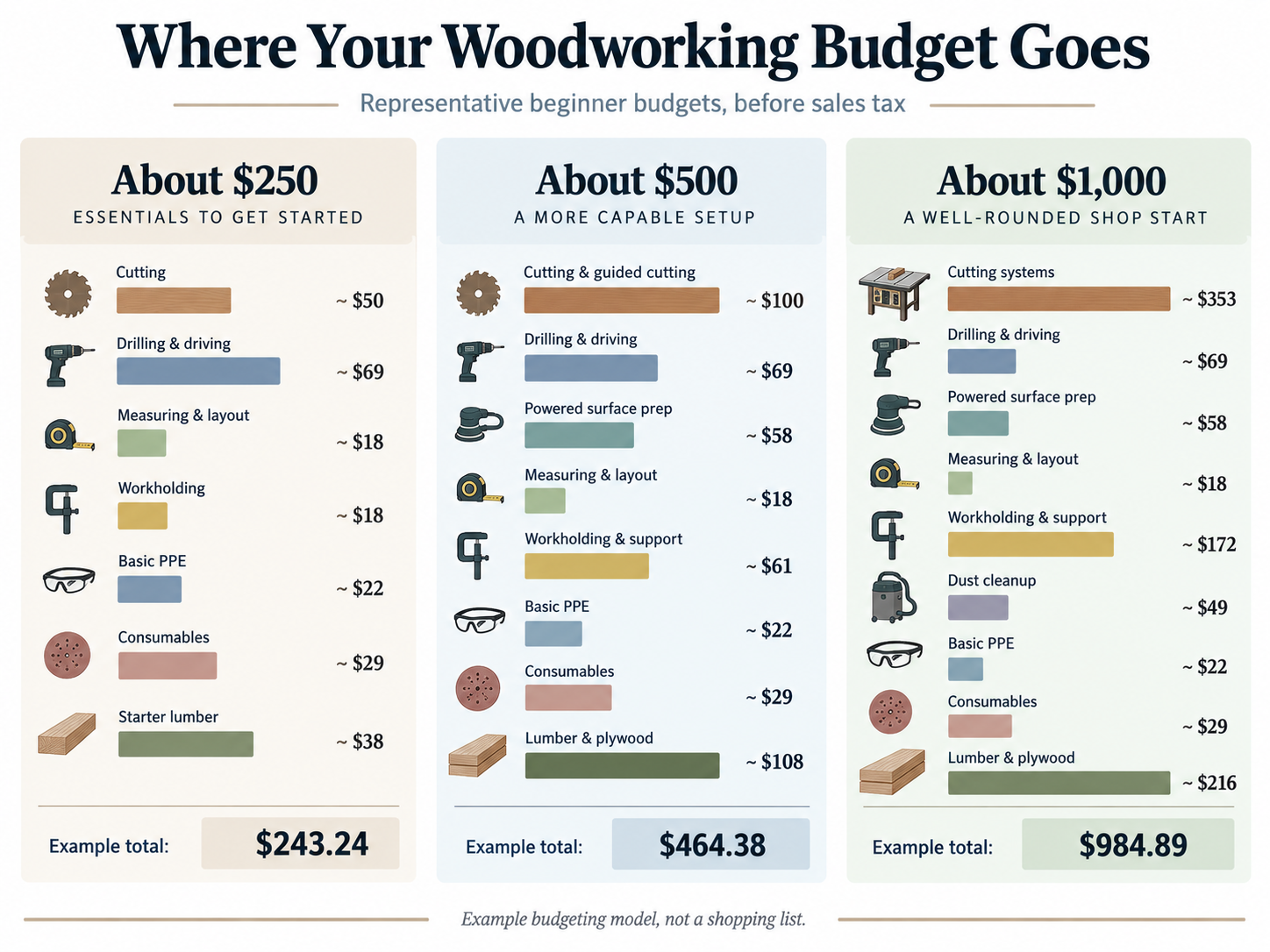
A Realistic $250 Woodworking Budget
At this level, the goal is not to build a miniature professional shop. The goal is to create a functional starting point.
Using representative new-tool prices from major U.S. retailers, our $250 model looked like this:
| Category | Example Allocation | What It Provides |
|---|---|---|
| Cutting | About $50 | A basic circular saw for board and panel cutting |
| Drilling & driving | About $69 | Drill/driver plus basic bits |
| Measuring & layout | About $18 | Tape measure and square |
| Workholding | About $18 | A small set of clamps |
| Basic PPE | About $22 | Eye, hearing and particulate protection examples |
| Consumables | About $29 | Glue, screws and hand-sanding abrasives |
| Starter lumber | About $38 | Enough inexpensive dimensional stock for a small project |
| Example total | $243.24 | Before tax |
What Does $250 Actually Let You Do?
This level gives you the ability to:
- measure and mark stock
- make basic crosscuts and rip cuts
- drill pilot holes
- drive screws
- glue small assemblies
- clamp small projects
- prepare surfaces by hand
That is enough capability for projects such as a simple tool tote, small storage box, planter, birdhouse, basic shelf or shop organizer.
The important word is simple. At this level, you have a functioning project setup, not a complete shop.
What Is Still Missing?
A $250 setup still involves compromises. There is no powered sander, no dedicated workbench, no dedicated dust-collection system and no separate saw for curves or rapid repetitive crosscuts.
That is not a failure of the budget. It is the point of the budget.
You start with enough capability to build, then let actual projects reveal what should come next.
A Realistic $500 Woodworking Budget
The jump from roughly $250 to $500 should not simply double the number of tools you own.
It should remove the bottlenecks that make early projects frustrating.
Our $500 model adds money for surface preparation, work support, larger workholding and more practical sheet-goods cutting.
| Category | Cumulative Allocation | Capability Added |
|---|---|---|
| Cutting & guided cutting | About $100 | Basic cutting plus a repeatable guide for sheet goods |
| Drilling & driving | About $69 | Same core drilling capability |
| Powered surface prep | About $58 | Random-orbit sanding plus abrasives |
| Measuring & layout | About $18 | Basic accurate layout |
| Workholding & support | About $61 | Clamps plus portable support for cutting |
| Basic PPE | About $22 | Eye, hearing and particulate protection examples |
| Consumables | About $29 | Glue, fasteners and abrasives |
| Lumber & plywood | About $108 | Dimensional stock plus a full sheet of plywood |
| Example total | $464.38 | Before tax |
Why $500 Is a Meaningful Threshold
At around $250, you can build.
At around $500, you start buying workflow.
Power sanding reduces the amount of manual surface preparation. Better work support makes cutting easier to organize. Larger clamps increase assembly options. A saw guide makes a circular saw more useful when working with plywood.
None of those additions is glamorous.
Together, however, they make a home woodworking setup much more capable.
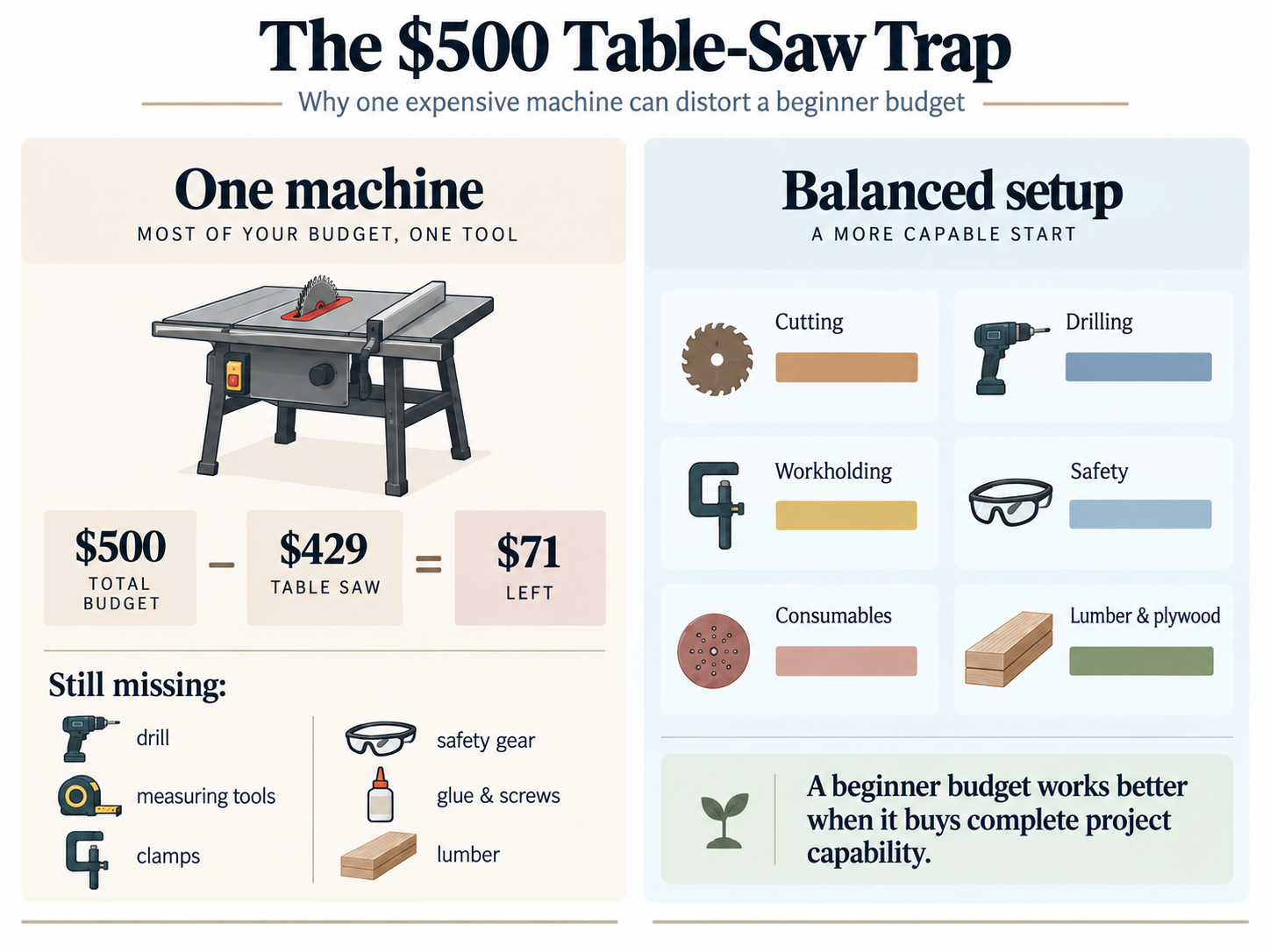
The $500 Table-Saw Trap
One of the clearest examples of why budget allocation matters is the table saw.
During our price check, a representative compact jobsite table saw was listed at about $429.
If your entire woodworking budget is $500:
$500 − $429 = $71 remaining
That remaining $71 would still need to cover some combination of:
- drilling
- measuring
- workholding
- safety equipment
- bits
- glue
- screws
- abrasives
- lumber
That does not mean a table saw is a bad tool.
It means a table saw can be a poor first allocation when the total budget is limited.
The more useful beginner question is not:
“What is the best machine I can afford?”
It is:
“What combination of capabilities lets me finish the projects I want to build?”
If you are deciding between a circular saw, jigsaw and miter saw, our beginner saw comparison looks at that decision separately.
A Realistic $1,000 Woodworking Budget
At $1,000, the temptation is to start buying machines simply because the budget allows it.
We think the money is better used to expand the range of operations you can perform.
Our example allocation looks like this:
| Category | Cumulative Allocation | Capability Added |
|---|---|---|
| Cutting systems | About $353 | Basic cutting, guided cuts, repeated crosscuts, curves and a finer-cut blade |
| Drilling & driving | About $69 | Core drilling and fastening |
| Powered surface prep | About $58 | Random-orbit sanding |
| Measuring & layout | About $18 | Basic accurate layout |
| Workholding & support | About $172 | Clamps, portable support and a compact work surface |
| Dust cleanup | About $49 | A basic wet/dry vacuum for cleanup and compatible-tool collection support |
| Basic PPE | About $22 | Eye, hearing and particulate protection examples |
| Consumables | About $29 | Glue, fasteners and abrasives |
| Lumber & plywood | About $216 | A larger material allowance for real projects |
| Example total | $984.89 | Before tax |
What Changes Between $500 and $1,000?
You are not simply accumulating more objects.
You are adding different kinds of cuts, better repeatability, better workholding, more convenient cleanup and enough material capacity to attempt larger projects.
This is where budget increases begin to change the kinds of geometry you can work with comfortably.
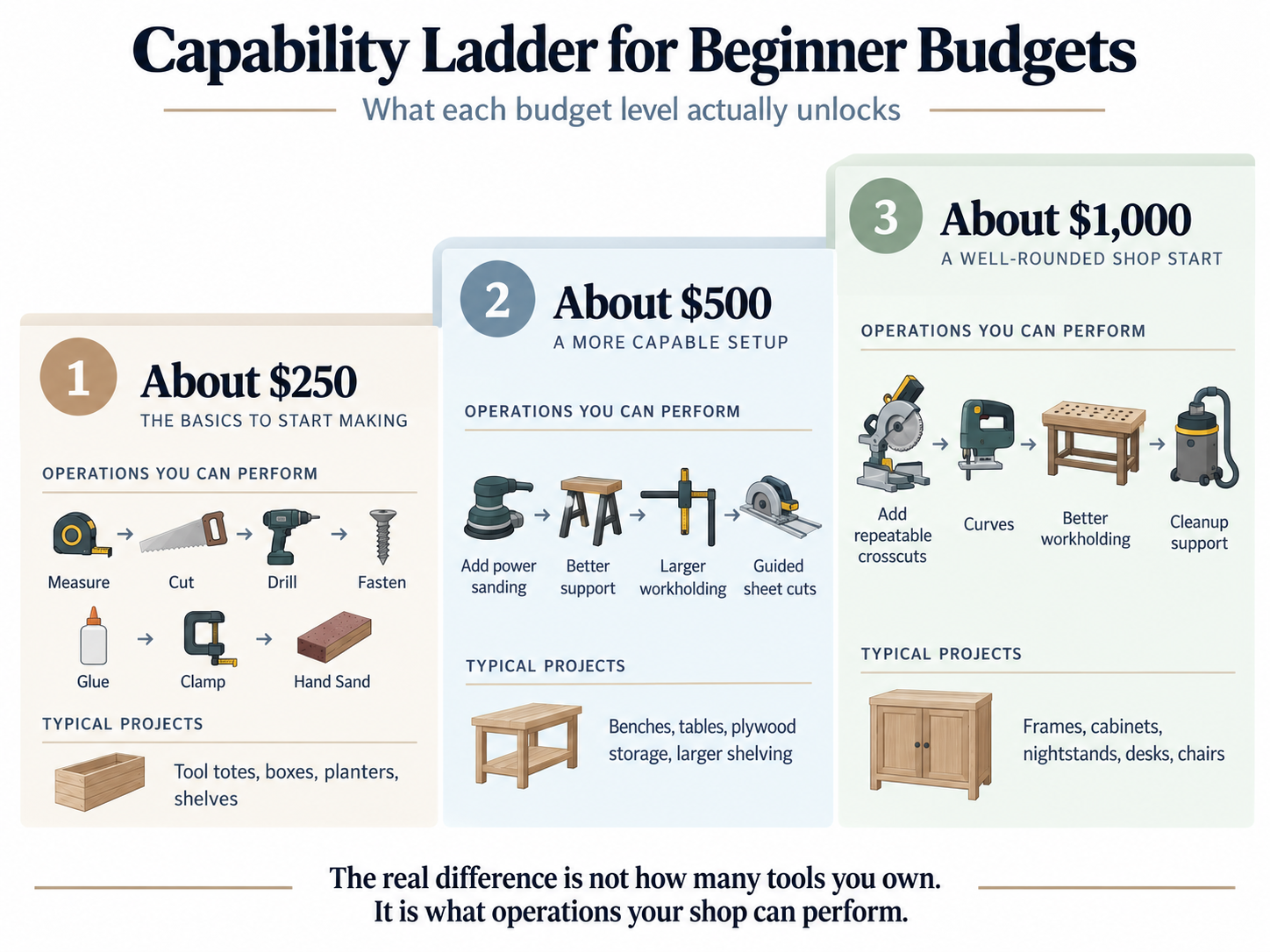
The KuduPost Capability Ladder
Another way to understand these budgets is to ignore brands completely and look only at capability.
Level 1 — About $250
Measure → Cut → Drill → Fasten → Glue → Clamp → Hand Sand
Typical project range: tool totes, small boxes, planters, shelves and simple shop projects.
Level 2 — About $500
Add Power Sanding → Better Support → Larger Workholding → Guided Sheet Cuts
Typical project range expands toward benches, tables, plywood storage, larger shelving and basic cabinet-style boxes.
Level 3 — About $1,000
Add Repeatable Crosscuts → Curves → Better Workholding → Cleanup Support
Typical project range expands toward frames, cabinets, nightstands, desks, chairs and more repeatable furniture work.
The important difference is not how many tools sit on the shelf.
It is what operations the shop can perform.
The Hidden Costs That Make Woodworking Feel Expensive
Power tools are easy to notice because they are large, expensive and heavily marketed.
The smaller expenses are less visible but often determine whether a project can actually be completed.
Durable purchases
- saws
- drill/driver
- square
- tape measure
- clamps
- sawhorses
- workbench
- shop vacuum
Recurring consumables
- sandpaper and sanding discs
- saw blades
- drill and driver bits
- screws
- glue
- disposable particulate protection
- vacuum filters or bags
Project-specific materials
- lumber
- plywood
- dowels
- hinges
- drawer slides
- finishes
- specialty fasteners
A beginner who budgets only for machines can repeatedly feel that woodworking is “unexpectedly expensive.”
Often, the expense was predictable—it was simply left outside the original tool budget.
Lumber Can Change the Budget Faster Than Tools
The material allowance in these examples uses relatively inexpensive, widely available stock as a baseline.
That does not mean every woodworking project has similar material costs.
Species, grade, thickness, dimensions and location can change lumber prices significantly. Clear pine, poplar, oak, maple, walnut and quality plywood can move the project budget far beyond a basic softwood example.
That creates an important distinction:
Tools are durable assets. Material gets consumed.
You may buy a drill once and use it for years.
You buy wood again for every project.
As projects get larger, the material budget can eventually exceed the cost of the tools used to build them.
Do You Need a Table Saw to Start Woodworking?
No.
That does not mean a table saw is unnecessary.
It becomes especially useful when your projects repeatedly require accurate, repeatable ripping and other operations that are easier with a stationary fence.
But for many beginners, a circular saw and guide can cover enough early project work to postpone that purchase.
We prefer this approach:
Let repeated project limitations tell you which tool to buy next.
If you repeatedly struggle with curves, a jigsaw begins to make sense.
If you repeatedly need fast, repeatable crosscuts, a miter saw becomes more valuable.
If repeatable ripping becomes a regular part of your work, a table saw becomes more compelling.
That is a much stronger buying signal than a generic “essential tools” checklist.
Should a Beginner Buy Cheap Tools?
Sometimes.
There is no useful universal rule that every beginner should either buy the cheapest possible tool or immediately invest in professional equipment.
A better question is:
Where does additional spending meaningfully improve accuracy, safety, reliability or workflow for the projects you actually build?
A measuring tool that is not reliably square can introduce errors into every project.
A basic clamp, on the other hand, may perform its simple job perfectly well without being premium.
A hobbyist drill does not necessarily need to survive full-time commercial use.
And even an excellent machine is expensive if you do not yet need the operation it performs.
What About Used Tools?
Used tools can stretch these budgets significantly.
We intentionally used representative new retail pricing for this article because it creates a repeatable baseline.
The used market is different in every city and changes constantly. One person may find an excellent used saw for a fraction of retail price while another may find nothing suitable for weeks.
Think of used tools as a way to potentially beat these budgets—not as a requirement for making the budgets work.
Do Not Cut the Safety Budget First
Safety equipment is inexpensive compared with most power tools, so it is a poor place to recover the last few dollars of a budget.
For context, OSHA workplace standards require appropriate eye protection where workers are exposed to hazards such as flying particles, and OSHA recognizes applicable ANSI eye-protection standards. OSHA’s hearing-conservation rules also use an 85 dBA eight-hour time-weighted average as an occupational action level. These are workplace standards, not residential hobby limits, but they demonstrate why eye and hearing protection belong in a serious woodworking budget.
NIOSH also documents health risks associated with wood-dust exposure.
Always follow the manufacturer instructions for each tool and each protective product you use.
And never defeat a saw’s built-in safety mechanisms. OSHA’s portable circular-saw standard, for example, describes upper and lower blade guards and requires the lower guard to return automatically to a covering position when the saw leaves the work.
Which Budget Should You Choose?
If you have about $250, you can start.
You do not need to wait until you can afford an entire workshop.
Build simple projects, learn how you like to work and discover which limitations appear repeatedly.
If you have about $500, this is the range we think offers the strongest balance between cost and capability for many beginners.
You gain better work support, faster surface preparation and more practical sheet-goods handling without filling the shop with machines.
If you have about $1,000, focus on building a balanced system rather than spending the entire budget on one premium machine.
Cutting, drilling, sanding, workholding, cleanup and material all matter.
Is Woodworking an Expensive Hobby?
It can be.
But it does not have to start that way.
Woodworking becomes expensive very quickly when the goal changes from:
“I want to build projects.”
to:
“I want to own a complete workshop.”
Those are not the same goal.
A beginner can accomplish meaningful work with a modest collection of tools and then let projects determine what comes next.
That keeps the workshop connected to the work instead of turning tool ownership into the project itself.
Final Verdict: How Much Should a Beginner Spend?
If you are completely new to woodworking, a budget of roughly $250 to $500 can be enough to begin seriously, provided the money is distributed across the entire project workflow rather than concentrated in one expensive machine.
Our September 2026 examples came to:
$243.24 — Functional Starter
Enough capability to measure, cut, drill, fasten, clamp, glue and finish simple projects.
$464.38 — Comfortable Beginner Setup
Adds powered sanding, better work support and more practical sheet-goods capability.
$984.89 — Broad Home-Shop Setup
Adds more cutting options, repeatability, workholding, cleanup support and a larger material allowance.
But the most important number in this article is not $250, $500 or $1,000.
It is:
$0 spent on tools you do not yet need.
Start with enough capability to finish a project.
Build it.
Pay attention to what slows you down.
Then spend your next dollar solving that problem.
That is how a useful tool collection gradually becomes a workshop.
Pricing methodology: The budget models in this article were built from representative new-tool and material prices observed at major U.S. retailers including Home Depot, Lowe’s, Walmart, Harbor Freight and Ace Hardware on September 14, 2026. Specific products were used only to establish realistic category costs, not as endorsements or purchase recommendations. Sales tax, shipping and regional price differences are not included.
Safety references: OSHA 29 CFR 1910.133 (Eye and Face Protection); OSHA 29 CFR 1910.95 (Occupational Noise Exposure); OSHA 29 CFR 1910.243 (Guarding of Portable Powered Tools); NIOSH Pocket Guide — Wood Dust.