If you are getting into woodworking and can afford only one power saw, the choice usually comes down to three tools: a circular saw, jigsaw, or miter saw.
They can all cut wood, but they solve very different problems.
For most beginners who want to build boxes, shelves, workshop projects, simple furniture, and projects that use both boards and plywood, we would start with a circular saw.
A jigsaw becomes the better first choice when curved cuts and cutouts are central to your projects. A miter saw makes more sense when you expect to make lots of fast, repeatable crosscuts in dimensional lumber.
The important question is not which saw is best? It is: Which saw unlocks the most useful projects for the kind of woodworking you want to do?
KuduPost methodology: This comparison is based on tool capabilities, manufacturer specifications, intended applications, workspace requirements, and common beginner woodworking tasks. It is not presented as a KuduPost laboratory test.
Quick Answer: Which Saw Should a Beginner Buy First?
For a typical beginner building projects at home:
- Start with a circular saw if: You want the broadest ability to cut boards and sheet goods such as plywood.
- Start with a jigsaw if: Your projects depend heavily on curves, shapes, interior cutouts, or decorative cuts.
- Start with a miter saw if: You mainly work with dimensional lumber and want fast, repeatable crosscuts and miters.
If you do not yet know exactly what you will build, the circular saw is our default recommendation because it covers the widest range of common beginner tasks with one portable tool.
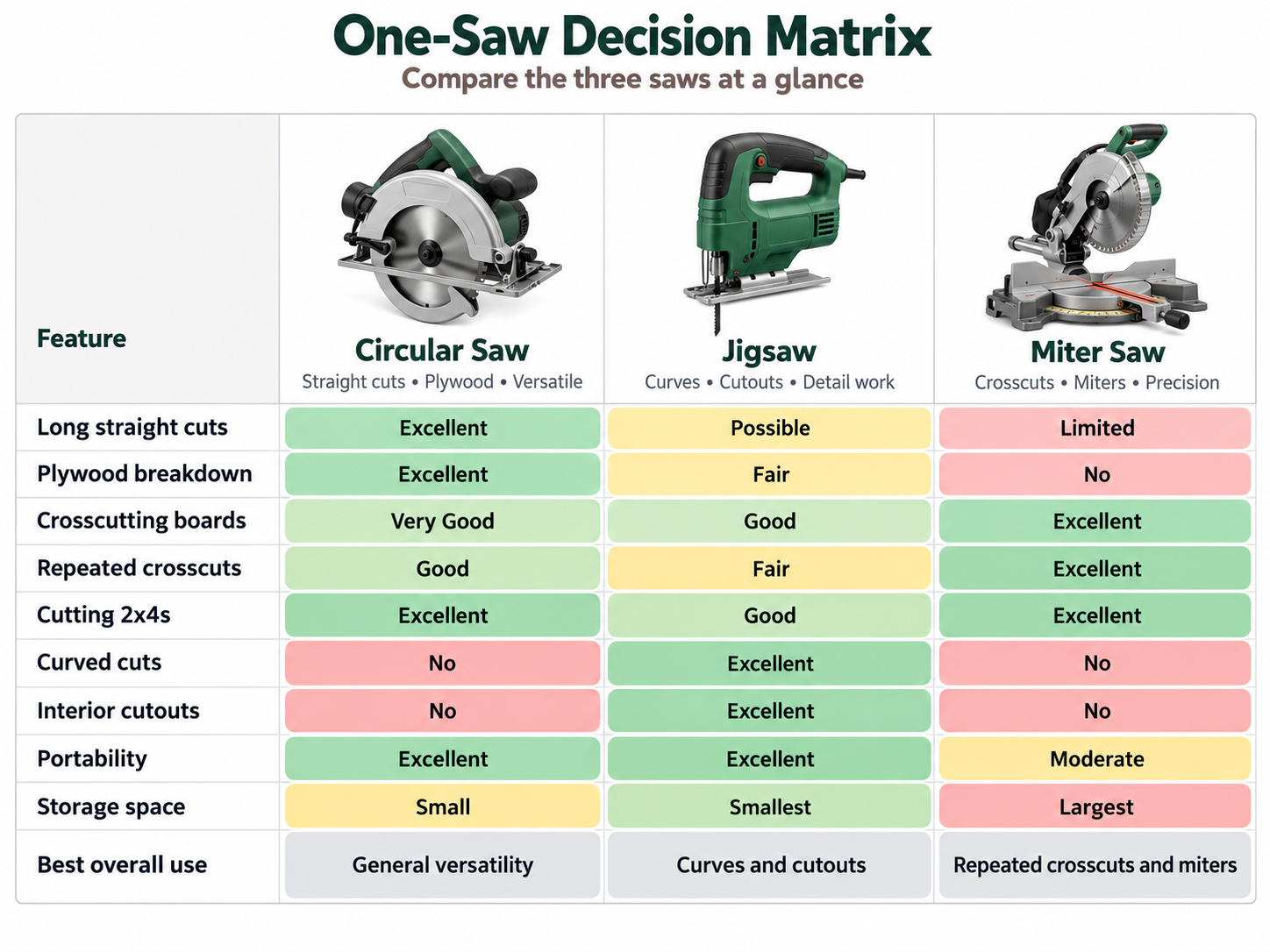
The KuduPost One-Saw Decision Matrix
Here is the comparison we wish existed when beginners were trying to choose their first saw.
| Task | Circular Saw | Jigsaw | Miter Saw |
|---|---|---|---|
| Long straight cuts | Excellent with a guide | Possible, but slower | Not its purpose |
| Plywood sheet breakdown | Excellent | Possible, but inefficient | Not designed for it |
| Crosscutting boards | Very good | Possible | Excellent |
| Repeated identical crosscuts | Good | Fair | Excellent |
| Cutting 2×4 lumber | Excellent | Possible with proper blade | Excellent |
| Curved cuts | No | Excellent | No |
| Interior cutouts | No | Excellent | No |
| Portability | Excellent | Excellent | Moderate |
| Storage requirement | Small | Smallest | Largest |
| General beginner versatility | Highest | Specialized | Specialized |
What a Circular Saw Does Best
A circular saw is essentially a portable straight-cutting machine.
Instead of bringing the board to a stationary saw, you move the saw through the material.
That makes it particularly useful for two types of material beginners encounter constantly:
- dimensional lumber such as 1x and 2x boards;
- larger sheet goods such as plywood.
A straightedge, cutting guide, or compatible guide rail can dramatically improve repeatability on long cuts.
Why that matters for beginners:
- a wooden storage box;
- garage shelves;
- a small workbench;
- a tool tote;
- simple plywood storage;
- a planter;
- a basic cabinet.
Most of those projects contain a large number of straight cuts.
Circular saw + straightedge = a much more capable beginner setup.
What a Jigsaw Does Best
The jigsaw is the most maneuverable of these three saws.
Its narrow reciprocating blade allows it to follow curves and enter shapes that a circular blade simply cannot make.
If your projects involve:
- curved shelves;
- decorative shapes;
- rounded corners;
- holes or interior cutouts;
- templates;
- irregular profiles;
the jigsaw quickly becomes invaluable.
Can a jigsaw make straight cuts?
Yes.
A jigsaw should not be described as incapable of making straight cuts. But being able to make a cut and being optimized for that cut are different things.
For small straight cuts, a properly set up jigsaw can work very well. But if your first projects require repeated long straight cuts in plywood or construction lumber, a circular saw is usually the more natural tool.
Choose the jigsaw first if your project list looks more like decorative signs, shaped shelves, craft builds, templates, and cutouts.
What a Miter Saw Does Best
A miter saw solves a completely different problem: fast, accurate, repeatable crosscuts.
You place a board against the fence, lower the saw, and make the cut.
That makes a miter saw particularly useful when you need multiple pieces cut to the same length or angle.
Think:
- picture frames;
- trim;
- repeated 2×4 cuts;
- outdoor projects;
- framing-style construction;
- furniture parts cut from relatively narrow boards.
The major limitation is that a miter saw is not a ripping tool for breaking down large plywood sheets.
This is why we consider a miter saw a fantastic second saw for many beginners—even though it may be the perfect first saw for someone whose projects revolve around dimensional lumber.
Circular Saw vs. Jigsaw: Which Is Better for a Beginner?
Choose the circular saw when your priority is straight cuts, plywood, shelves, boxes, furniture panels, and construction lumber.
Choose the jigsaw when your priority is curves, cutouts, irregular shapes, and decorative woodworking.
For general-purpose home woodworking, we give the circular saw the advantage. For craft-oriented or curved work, the jigsaw wins easily.
Circular Saw vs. Miter Saw: Which Should You Buy First?
If you work mostly with plywood and mixed materials, choose a circular saw.
If you work mostly with boards and repeated crosscuts, choose a miter saw.
If workshop space is tight, the circular saw also has an advantage because it stores more easily.
Jigsaw vs. Miter Saw: Two Completely Different Tools
A jigsaw excels when the cutting path moves.
A miter saw excels when the material needs to be cut repeatedly at controlled angles.
If you want to cut a curved profile, choose the jigsaw. If you want to cut twelve boards to the same length, choose the miter saw.
Which Saw Fits the Projects You Actually Want to Build?
- Wooden tool tote: Best fit: Circular saw
- Simple wooden storage box: Best fit: Circular saw
- Birdhouse: Best fit: Circular saw or miter saw
- Picture frame: Best fit: Miter saw
- Plywood shelving: Best fit: Circular saw
- Decorative curved shelf: Best fit: Jigsaw
- Basic workbench built from 2x4s: Best fit: Miter saw or circular saw
So Which Saw Gives You the Most Projects?
For the beginner profile we are targeting—someone building general home woodworking projects with limited space and budget—we would buy the tools in this order:
- Circular saw — General straight-cut capability.
- Jigsaw or miter saw — Choose based on whether your projects introduce curves or repetitive board cutting first.
- The remaining saw — Buy it when a project genuinely requires its specialty.
Every new tool should solve a problem your existing setup cannot solve efficiently.
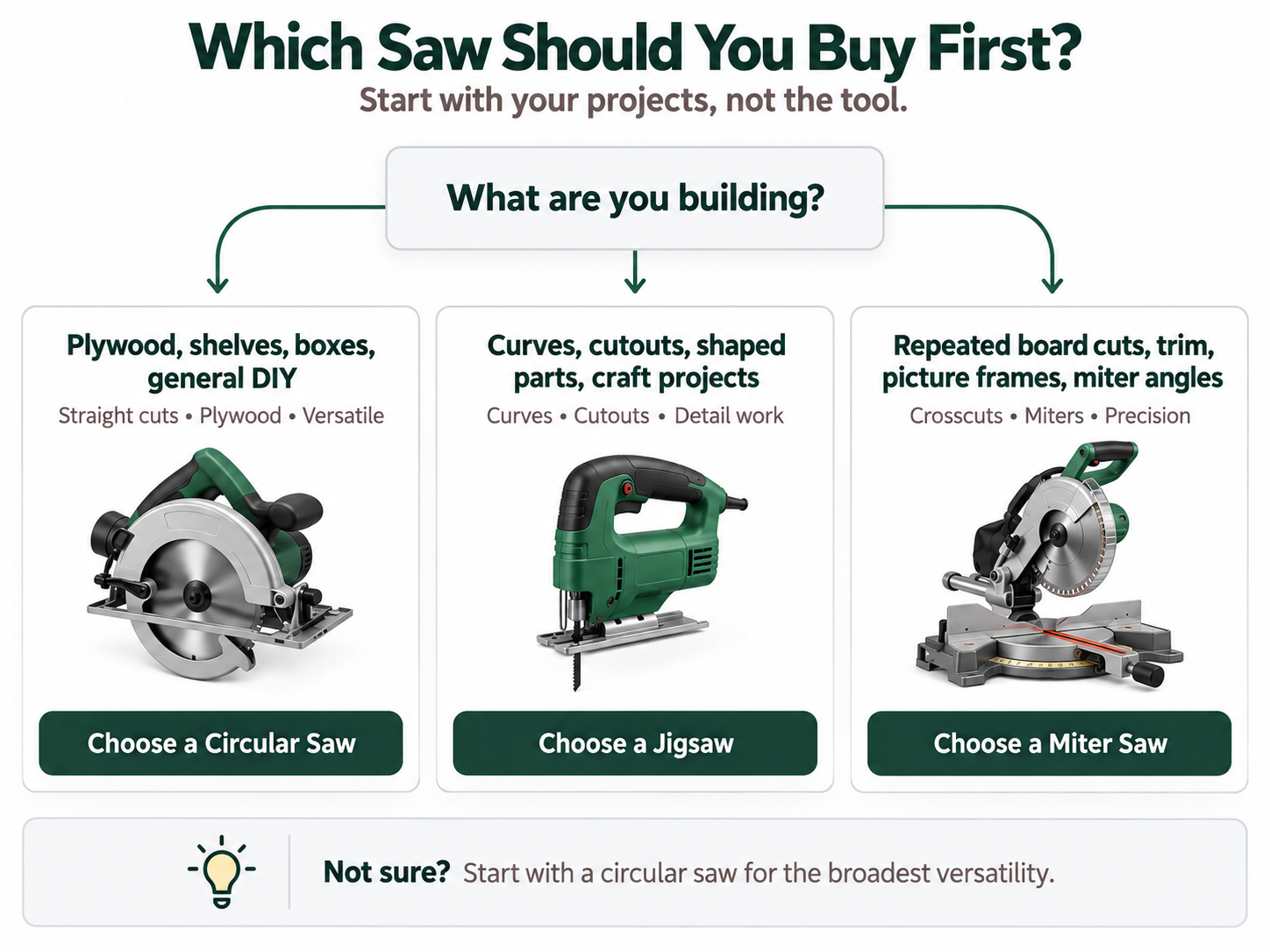
The KuduPost One-Saw Decision Tree
Ask yourself these three questions.
- Do you expect to cut plywood or make long straight cuts? Yes → Circular Saw
- Are curves, cutouts, and shaped parts central to your projects? Yes → Jigsaw
- Are you mostly cutting boards repeatedly to length or at precise miter angles? Yes → Miter Saw
If you answered “I don’t know” to all three: Start with the circular saw.
Safety Basics Before Your First Cut
Whichever saw you choose, read the manual for the specific model before using it. Different saws have different adjustment procedures, blade requirements, workholding instructions, and operating limitations.
For circular saws in particular, blade guards are a critical safety feature.
For a home woodworker, the practical lesson is simple: Do not defeat, pin back, or intentionally disable the blade guard.
Also:
- use the blade specified for the saw and material;
- support the workpiece so the cut does not pinch the blade;
- keep hands clear of the cutting path;
- secure unstable workpieces;
- allow the blade to stop before setting the tool down;
- disconnect power or remove the battery before blade changes or adjustments;
- follow the manufacturer’s eye, hearing, and other PPE guidance.
Final Verdict: Circular Saw vs. Jigsaw vs. Miter Saw
There is no universal “best saw.” There is, however, a best fit for a particular beginner.
- Buy a circular saw first if: You want maximum flexibility for general woodworking, straight cuts, plywood, dimensional lumber, shelves, boxes, and basic furniture projects. This is our recommendation for most beginners who can buy only one power saw.
- Buy a jigsaw first if: Your work centers on curves, interior cutouts, decorative shapes, and smaller craft projects.
- Buy a miter saw first if: You mainly cut dimensional lumber and prioritize speed, repetition, and controlled crosscuts or miter angles.
The biggest beginner mistake is not choosing the “wrong” saw. It is buying tools before knowing what problem they are supposed to solve.
Start with your first few projects. Identify the cuts they require. Then buy the saw that unlocks those cuts.